
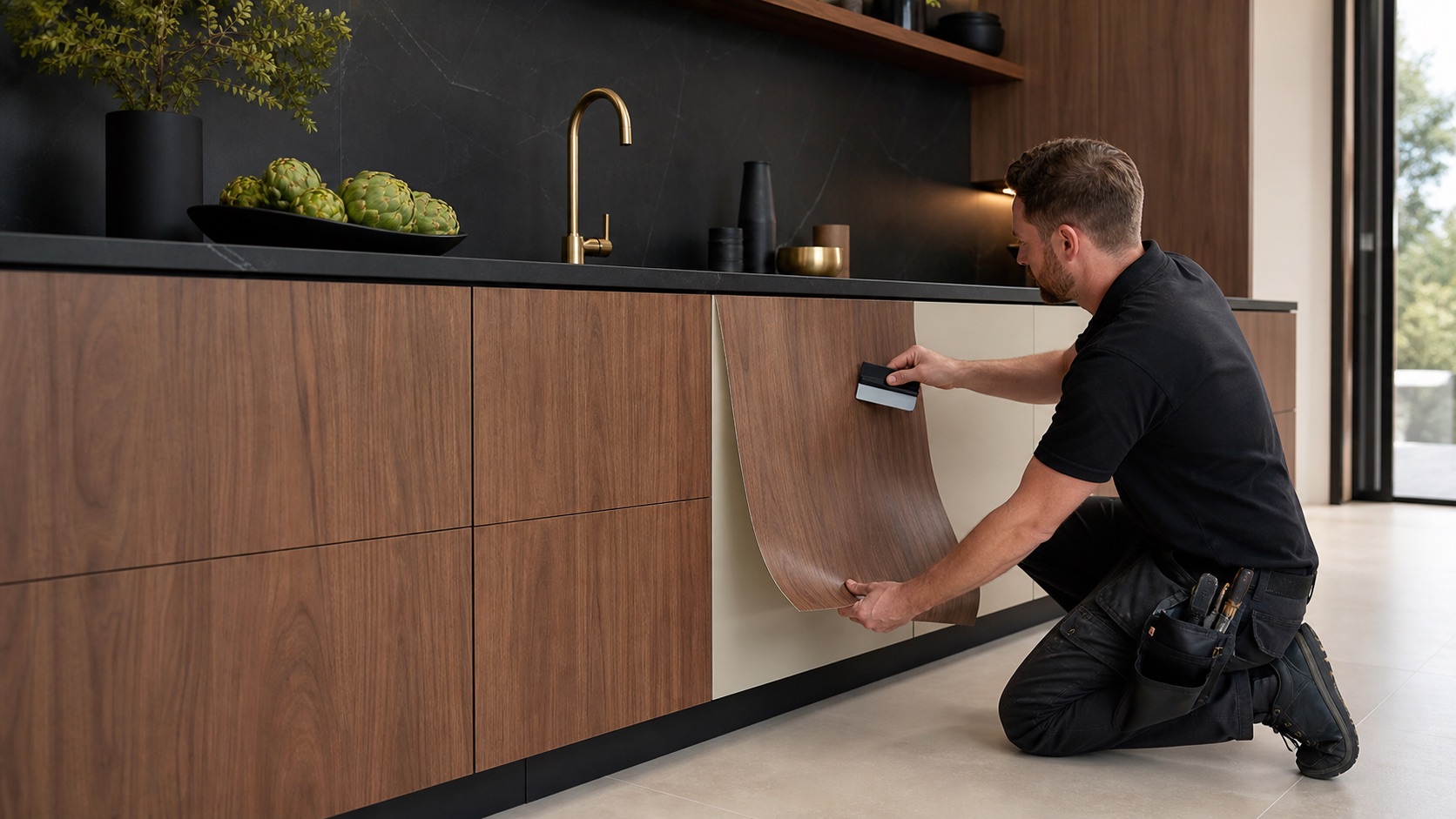
Architectural vinyl finishes in Jacksonville that refresh cabinets, walls, doors, counters, fixtures, and commercial interiors without the waste and downtime of demolition.
“Wrapping a house” sounds strange because a home is not wrapped from roof to foundation like a car. The real service is more specific: architectural vinyl finishes are durable decorative films applied to suitable interior surfaces. They can give cabinets, doors, panels, counters, walls, reception desks, elevator interiors, and fixtures the appearance of wood, stone, metal, solid color, or another finish without removing and replacing every component.
For a Jacksonville homeowner, that can mean changing dated cabinet fronts without sending intact boxes to a landfill. For a business, it can mean refreshing customer-facing surfaces without closing for a long construction schedule. The opportunity is real—but only when the substrate, product, edge details, heat exposure, moisture, and expected use all make sense.
Where architectural film works well
Smooth, stable, properly prepared surfaces are the best candidates. Cabinet doors and flat panels can take on a new wood grain or color. Interior doors and built-ins can be unified with an updated palette. Reception desks, columns, wall panels, and display fixtures can be refinished to support a commercial interior concept. Some counter and table applications may be appropriate with products designed for that use and realistic expectations about heat, cutting, and impact.
Architectural film follows the surface below it. It does not erase deep texture, swelling, loose paint, damaged laminate, failing veneer, grease contamination, or moisture problems. Repairs and cleaning are not optional; they are part of deciding whether wrapping is sensible at all.
A residential refresh without a full teardown
Cabinet replacement changes layout and storage, but many kitchens do not need a new box system. If the existing cabinet fronts are sound and the goal is visual, film can create a focused transformation with less material waste and disruption. Wood patterns can add warmth, solid colors can simplify a busy room, and stone or metal accents can change selected surfaces without dominating the space.
The design should consider handles, edges, appliance colors, backsplash, counters, flooring, and natural light. A sample viewed under showroom lighting can feel different in a Jacksonville kitchen at noon. Testing the material in the actual room is a better way to judge scale, grain, sheen, and undertone.
Commercial interiors that cannot wait for demolition
Retail, office, hospitality, multifamily, and service spaces often need to update finishes while remaining operational. Architectural vinyl can be staged by zone, keeping more of the existing fixture or millwork in place. Reception desks, corridor panels, elevator cabs, office doors, point-of-sale counters, and built-ins are common candidates.
Commercial use raises additional questions: cleaning chemicals, traffic, edge exposure, fire and building requirements, tenant-improvement rules, and the lifespan expected from the finish. Product selection should match the environment rather than relying on a decorative household contact paper. An architectural surface film is a professional material system, not a shortcut roll from a craft aisle.
Preparation makes or breaks the surface
The work begins by identifying the substrate and its condition. Hardware may need removal. Grease, silicone, wax, and residue must be eliminated. Loose coatings and damage need correction. Corners, seams, cutouts, and edge locations are planned before installation so the finish reads as one surface rather than a series of patches.
Film is then measured, placed, and applied with controlled pressure and heat where the product requires it. Grain direction and pattern continuity matter. On doors and cabinet fronts, the relationship between adjacent pieces can make the difference between an intentional millwork look and a random collection of samples.
Durable does not mean indestructible
A quality architectural film can stand up to normal use when specified and installed correctly, but it is still a finish layer. Direct flame, hot cookware, sharp blades, standing moisture, aggressive cleaners, and repeated heavy impact can damage it. Some applications need edge sealing or a different material entirely. The honest answer is sometimes to repair, paint, laminate, or replace rather than wrap.
Maintenance is usually simple: gentle cleaner, a soft cloth, and prompt attention to spills. Care instructions should match the exact film. If the project is commercial, the cleaning team should receive those instructions so a strong solvent does not undo careful work.
How to request an architectural wrap quote
Send wide photos of the room or commercial area, close photos of the surface and edges, rough measurements, the existing material if known, and inspiration for the desired finish. Mention heat, water, cleaning, and traffic conditions. A cabinet door near a range is not the same application as an office wall panel, even when both look flat in a photograph.
From there, we can identify promising surfaces, flag likely limitations, discuss samples, and determine whether a site review is needed. The goal is a refined new finish with a practical reason behind it—not wrapping something simply because film can stick to it.
Architectural vinyl FAQs
What does architectural vinyl wrapping mean?
It means applying professional decorative film to suitable cabinets, walls, doors, counters, panels, or fixtures. It does not mean wrapping an entire exterior house.
Can film cover damaged cabinets or walls?
Film follows the substrate. Loose coatings, deep texture, moisture damage, grease, swelling, and structural problems must be corrected before installation.
Is architectural film only for homes?
No. It can be useful in offices, retail, hospitality, multifamily, and other commercial interiors where downtime and demolition matter.